
 Hussain Ali
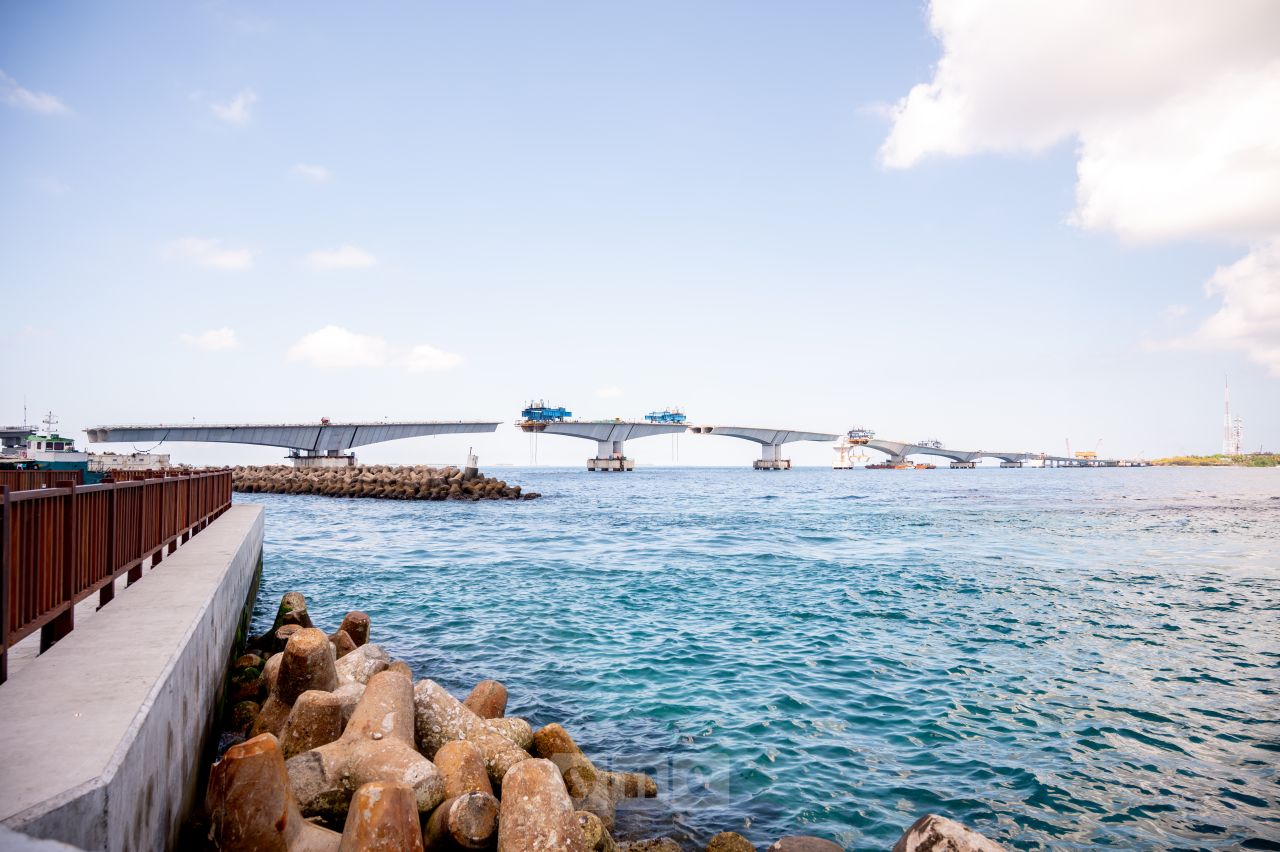
Due to land scarcity for establishing water treatment facilities across the Greater Malé region, studies are underway to explore installing a desalination plant at a depth of 500 meters underwater beneath the Malé–Vilimalé bridge area, Managing Director of Male’ Water and Sewerage Company (MWSC) Hussain Fahumy has said.
Speaking on Dhivehi Raajjeyge Adu’s radio program Ahaashey Bunaanan, Fahumy stated that among MWSC's upcoming plans, the earliest project scheduled to begin is laying water supply pipelines across the bridge connecting to Thilafushi to supply Malé.
"The next major project to commence is supplying water to Malé via the bridge being constructed to Thilafushi. The government plans to establish water storage on state-owned land in Thilafushi and supply water to Malé and Hulhumalé. We are working closely with the government to ensure this work can commence by the time the bridge is completed," Fahumy said.
Fahumy explained that MWSC is partnering with an expert team from Norway to carry out this project. A Memorandum of Understanding (MoU) has been signed to initiate the work, with feasibility, technical, and environmental impact assessments currently in progress. Physical implementation is targeted to commence around the middle of next year.
"Alongside this, we are also advancing research into subsea water production. By placing a water plant approximately 500 meters under the sea, we are first assessing the required financial investment and overall costs. This approach offers significant advantages: enhanced energy efficiency, seamless brine discharge back into the sea, and access to exceptionally pure deep-sea water. It is far cleaner than water drawn from boreholes, with minimal organic matter and trace metals," Fahumy stated.
Fahumy highlighted that successfully completing this project would lower production costs and eliminate the recurring challenge of finding onshore space for desalination infrastructure.
"This will lead to reduced water production costs, addressing the severe shortage of land to house water plants in Malé. If subsea water production proves viable, it will represent a major advancement for an island nation like the Maldives. The Norwegian team has extended an invitation to inspect their existing successful projects and conduct further studies on the project's viability for the Maldives. This will be a massive, transformative project," Fahumy said.
 News
News  News
News  Business
  Business