
 Hussain Ali
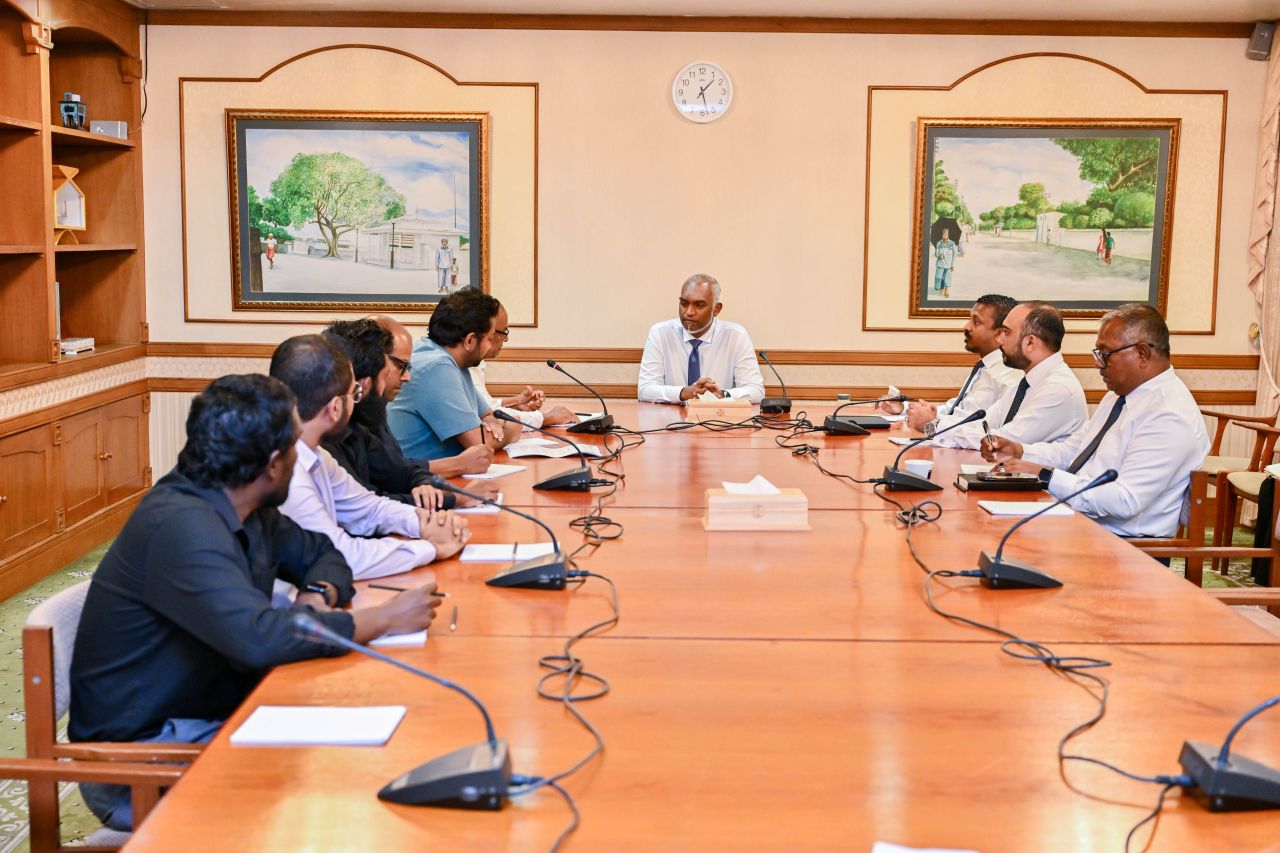
President Dr Mohamed Muizzu on Thursday met with the Maldives Journalists Association, following a request by the representative body to discuss their concerns regarding the Maldives Media and Broadcasting Regulation Bill.
The bill proposed by Thulhaadhoo constituency member Abdul Hannan Abubakur was accepted yesterday in an extraordinary parliamentary sitting. The bill is now at the committee stage.
During the discussion, the President attentively considered all recommendations and pledged due regard. Lasting over an hour, the meeting reaffirmed his commitment to addressing journalists’ concerns. He underscored that this Administration is “100 per cent pro-media” and reaffirmed the Government’s ongoing support for the sector. The President also highlighted that numerous initiatives have been undertaken, and continue to be implemented, to foster a favourable and enabling environment for the media.
He further reaffirmed that he has no intention for the Government to interfere in media regulation, control, or appointments to regulatory bodies. The President assured that the Government would propose amendments to certain provisions of the bill currently under deliberation in Parliament.
The President assured the Maldives Journalists Association that the Government remains committed to supporting and safeguarding media freedom in the Maldives.
The journalists who went to the President's Office for this meeting were Hussain Fiyaz Moosa, Chief Editor of Adhadhu; Hiriga Ahmed Zahir, Chief Editor of Dhauru; Nazim Hassan from Mihaaru; Junaid Saleem from the Maldives Journalist Association (MJA); and Nahudha Faiz, a member of the Maldives Media Council (MMC).
The bill proposed by Hannan suggests changes to the composition of the Media Commission. According to the bill, the Commission will consist of three members appointed by the President and four members elected by the media. The members appointed by the President need parliamentary approval.
The media members of the Commission will be elected through an election conducted by the Elections Commission as per regulations made under this law.
The method of appointing the Commission's president and vice president has also been changed. According to the bill, the President will only appoint the Commission's president. The vice president will be elected through a secret ballot among the Commission members.
The Media Bill includes provisions for significant measures against media outlets and individual journalists.
These include fines for journalists and media outlets violating the code of conduct set by the Media Commission, with the possibility of revoking registrations. Individual journalists can be fined between MVR 5,000 and MVR 25,000, while media outlets can be fined up to MVR 100,000.
Powers granted to the Media Commission by this bill include:
- Fining journalists between MVR 5,000 and MVR 25,000 for violating the code of conduct.
- Fining media outlets up to MVR 100,000 for violating the law.
- Temporarily revoking registration even before an investigation is completed.
- Revoking a newspaper's registration through court.Blocking a newspaper's website while investigating a case.
 News
News  Entertainment
  World
World  News
News