
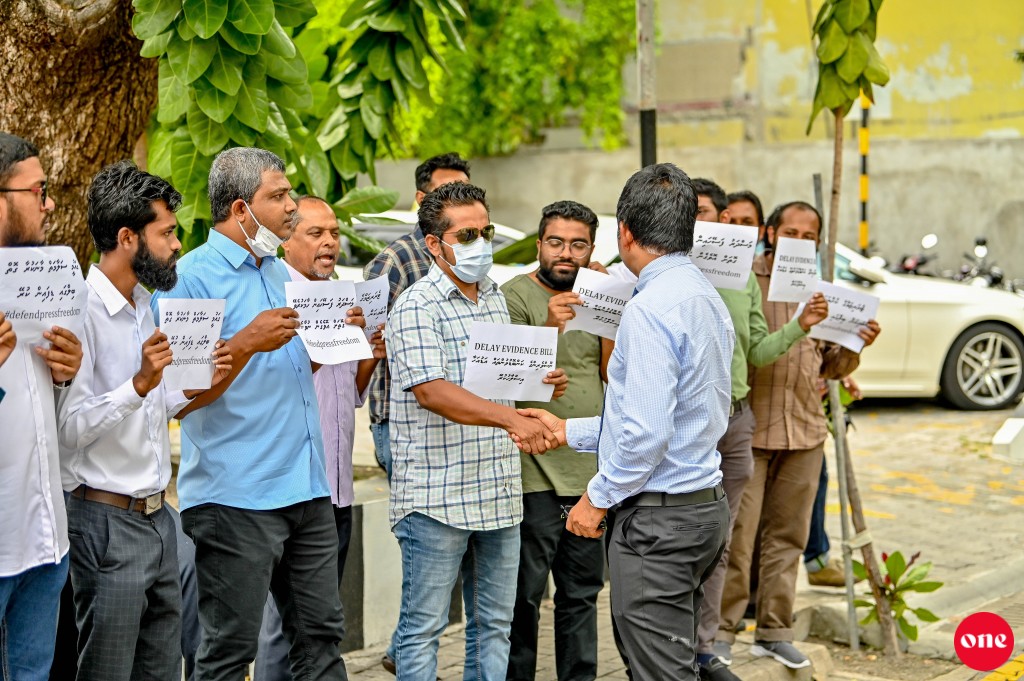
The Maldives Journalists Association (MJA) and the Editors Guild have condemned the government's decision to block three websites criticising the government.
The Communication Authority of Maldives (CAM), which comes under the Ministry of Cities, Local Government and Public Works, has blocked kurusee.com and dhiyavaru.com, citing the reason for blocking the sites as the websites being unregistered.
In a statement issued today, the Editors Guild said that in civilised societies, websites used to disseminate news and information do not necessarily need to be registered, and that newspapers have been operating in the Maldives without registration since the early 2000s.
"We demand that the two websites be allowed to be re-operate as long as the actual reason for blocking them are not disclosed," the Editors Guild said in a statement.
The Editors Guild said Article 27 of the Constitution guarantees freedom of speech and expression in accordance with the tenets of Islam and that the government has not officially banned the operation of newspapers without registration.
"At the same time, the state should insist on bringing true information to the public and state agencies should not obstruct the media. If that is not the case, those who provide accurate information will not be able to provide accurate information to the public," the Editors Guild said.
The MJA said the blocking of kurusee.com, dhiyavaru.com and a registered newspaper, furathama.com, was a sign of the government's threat to citizens and journalists, and that it was an affront to democracy as it was an impediment to the right to information, freedom of the press and freedom of expression.
The MJA said the Association supports combating unverified information, but blocking the website is not a solution to prevent the spread of unverified information. The law places the onus on the Maldives Media Council (MMC) to uphold the ethical standards of journalism and prevent the spread of unverified information, MJA said.
"Non-registered newspapers are also regulated by MMC and recognised as media by the Act, and if there is a problem with websites, the law makes it mandatory for MMC to look into it and take action. The government's entry into it and taking action by blocking the websites is not the way the legal system is structured," the MJA said.
The MJA said that the spread of unverified information can be curbed only if the government helps in creating awareness among the public and conducting fact-checking professionally.
 News
News  News
News  News
News  News
News