
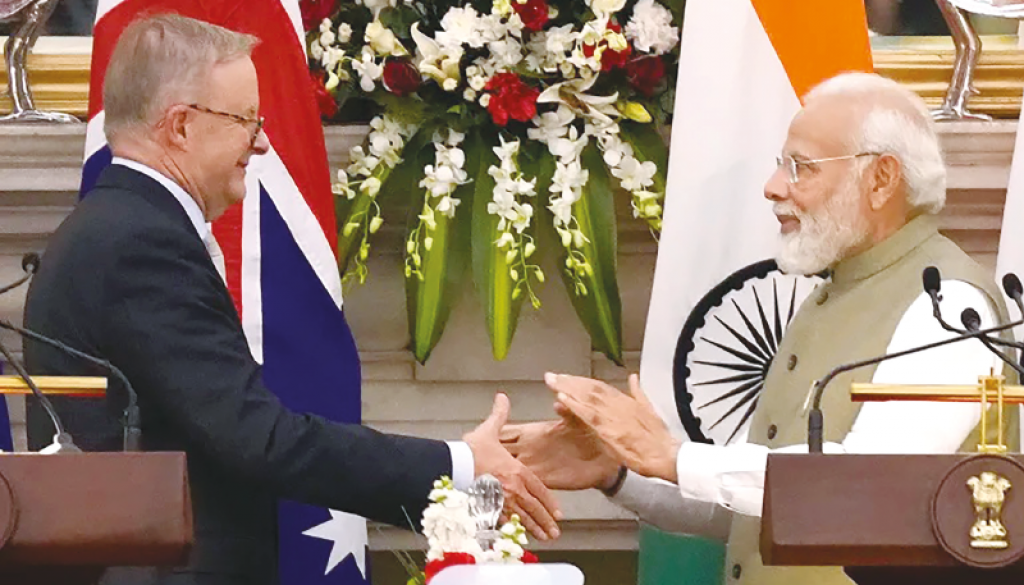
India and Australia have agreed to accelerate a broader economic partnership and to boost their defence ties, Australian Prime Minister Anthony Albanese says.
Last year, the two countries signed a free trade deal, called the Economic Cooperation and Trade Agreement (ECTA), the first signed by India with a developed country in a decade.
However, a much larger Comprehensive Economic Cooperation Agreement (CECA) has been stuck in negotiations for more than a decade. Discussions between the countries restarted in 2011 but were suspended in 2016 as the talks were gridlocked.
Negotiations resumed in 2021 but a deal has yet proved to be elusive.
“We also agreed on an early conclusion of our ambitious Comprehensive Economic Cooperation Agreement as soon as possible and I am hopeful that we will be able to finalise that this year,” Albanese, who is visiting India, told reporters in New Delhi on Friday.
“This transformational deal will realise the full potential of the bilateral economic relationship, creating new employment opportunities and raising living standards for the people of both Australia and India.”
He said Australia and India made “significant and ambitious” progress in strengthening defence and security ties and also discussed climate change issues.
Bilateral trade between the countries was at $27.5bn in 2021 and India says trade has the potential to nearly double to $50bn in five years under the ECTA.
In the 2022 fiscal year, India was Australia’s ninth-largest trading partner and they hope to double trade in the next five years.
India’s exports to Australia totalled $8.3bn and imports from the country stood at $16.7bn in 2021-22, according to the economic think tank Global Trade Research Initiative.
While India’s exports range from agriculture, garments and railway engines to telecom, 95 percent of India’s imports from Australia are raw materials and mining products needed by Indian industry.
 World
World  World
World  World
World  World
World