
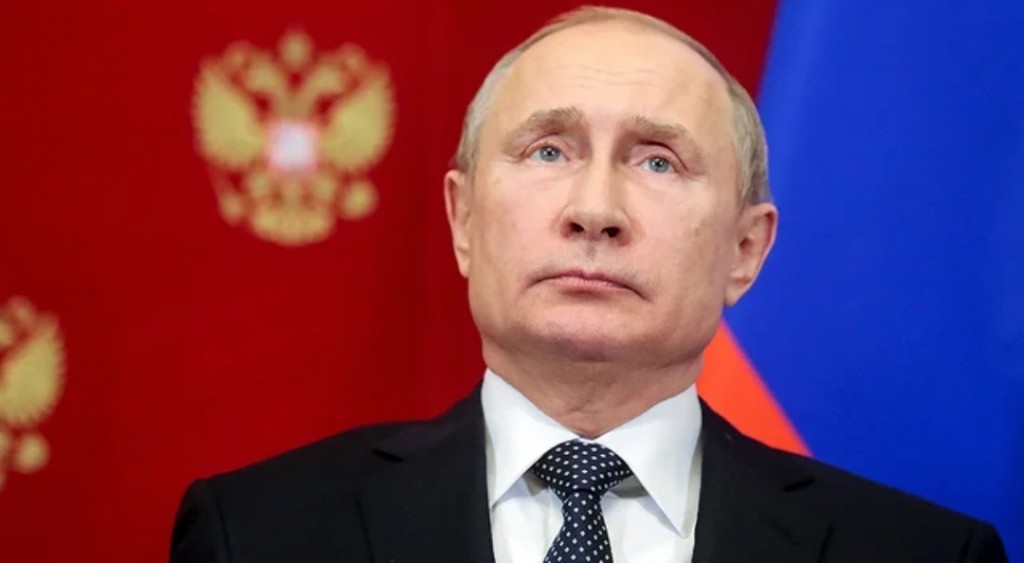
China's leader Xi Jinping and Russia's Vladimir Putin will discuss the war in Ukraine and other "international and regional topics" at their meeting later this week, the Kremlin says.
The two will meet in Uzbekistan at a summit that will show an "alternative" to the Western world, the Kremlin said.
Mr Xi is making his first trip overseas since the beginning of the pandemic.
He is seeking a historic third term while Mr Putin's relations with the West are at rock bottom over Ukraine.
Mr Xi is beginning his three-day trip in Kazakhstan on Wednesday. He will then meet Mr Putin on Thursday at the Shanghai Cooperation Organisation (SCO) Summit in Samarkand, which will run from 15-16 September.
Mr Putin will also meet other leaders including those of India, Pakistan, Turkey and Iran - but his meeting with China's leader "is of particular importance," said Kremlin foreign policy spokesman Yuri Ushakov.
He said the summit was taking place "against the background of large-scale political changes".
China and Russia have long sought to position the SCO, founded in 2001 with four ex-Soviet Central Asian nations, as an alternative to Western multilateral groups.
Mr Xi's visit comes amid a fresh set of lockdowns in China, where his zero Covid policy is still in place. While the rest of the world has opened up, learning to live with with the virus, Beijing continues to shut down entire cities and provinces every time there is a spurt in cases.
Mr Xi last left China in January 2020 to visit Myanmar - just days before the first lockdown came into effect in Wuhan. He has remained in China since then, leaving the mainland only once in July this year to visit Hong Kong.
As Russian forces suffer a string of stunning defeats in Ukraine, Moscow is playing up Beijing’s support for its invasion ahead of a key meeting between Russian President Vladimir Putin and Chinese leader Xi Jinping this week.
Russian troops were forced to flee the strategic city of Izium – their main bastion in northeastern Ukraine – on Saturday after a swift Ukrainian counteroffensive.
It was Moscow’s worst defeat since its retreat from Kyiv in March – and a sign that the war might be entering a new phase. Over the past week, Ukrainian forces have recaptured more than 3,000 square kilometers of territory – more than Russian forces have captured in all their operations since April.
Back in Russia, senior Russian and Chinese officials put on a united front to pave the way for an expected meeting between Putin and Xi on the sidelines of a regional summit in Uzbekistan – their first face-to-face meeting since Russia’s invasion of Ukraine.
And according to the Russian Parliament, a senior Chinese leader has voiced explicit support for Russia’s war on Ukraine – claims that are not included in the statement from the Chinese side, and run contrary to Beijing’s previous efforts to maintain a veneer of neutrality.
On Thursday and Friday, China’s top legislator Li Zhanshu – a close ally of Xi and third-ranking leader of the Chinese Communist Party – met with Vyacheslav Volodin, chairman of Russia’s State Duma, and other Russian lawmakers in Moscow after attending an economic forum in the eastern city of Vladivostok.
According to a statement from the State Duma, Li assured its members that “China understands and supports Russia on issues that represent its vital interests, in particular on the situation in Ukraine.”
“We see that the United States and its NATO allies are expanding their presence near the Russian borders, seriously threatening national security and the lives of Russian citizens. We fully understand the necessity of all the measures taken by Russia aimed at protecting its key interests, we are providing our assistance,” Li was quoted as saying.
“On the Ukrainian issue, we see how they have put Russia in an impossible situation. And in this case, Russia made an important choice and responded firmly,” he added.
Beijing has firmly refused to condemn Russia’s invasion of Ukraine – or even refer to it as a “war.” Instead, it has repeatedly laid the blame for the conflict on NATO and the United States.
 World
World  World
World  World
World  World
World