
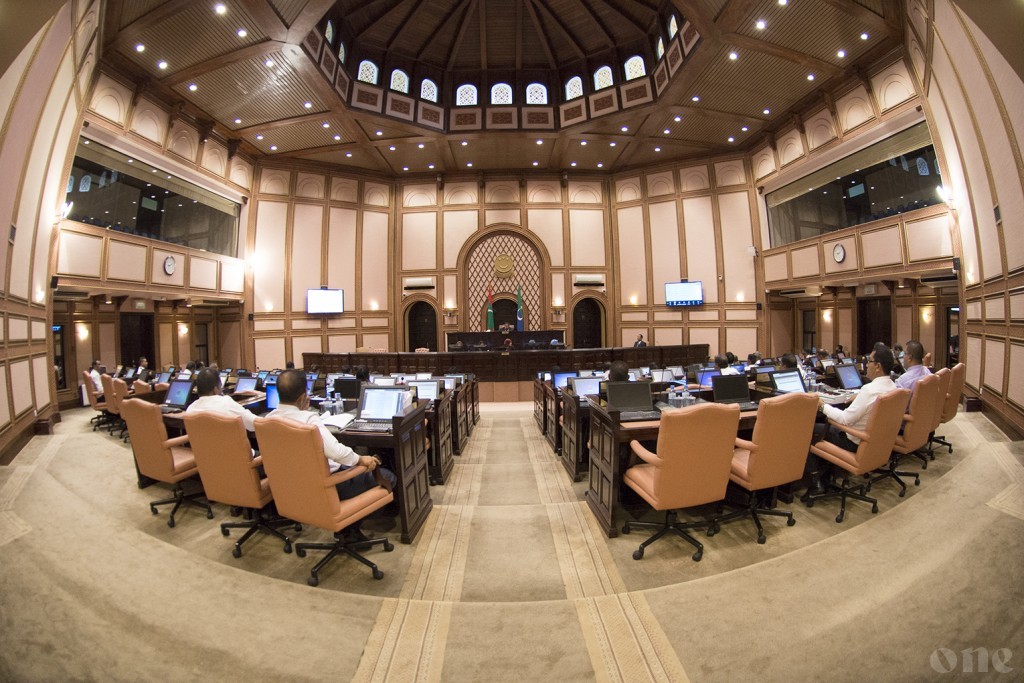
Facing a delay of three sittings, the Bill to empower Presidential Commissions on asset recovery and investigation of deaths and disappearances, have been removed from the Agenda at Parliament today.
The Presidential Commissions being empowered by the Bill involve the Commission on Investigation of Murder and Enforced Disappearances as well as the Commission on Corruption and Asset Recovery.
Speaker of Parliament, Qasim Ibrahim has moved to remove the Bill from the Agenda and transfer it back to the Parliamentary Committee.
The Speaker of Parliament has noted that the Bill initially proposed by the MP of Alifushi constituency, Mohamed Rasheed Hussain and passed through the Parliamentary Committee on Independent Institutions. Qasim said however that the Bill presented for debate was different from what had been approved by the Committee and that six members of the Committee had submitted a letter noting this change.
Qasim reiterated that the Bill cannot move forward at Parliament without an investigation and as such, has transferred the Bill out of the agenda at Parliament.
The Speaker had then requested the Parliamentary Committee on Independent Institutions to reach a conclusion regarding the Bill once again. Various members of Parliament from Maldivian Democratic Party (MDP) have however expressed their outrage regarding the Bill being taken out of the Parliamentary agenda.
This has been the forth sitting at which there has been an attempt to pass the Bill at Parliament.
While the other sittings saw that the quorum was not being fulfilled to a point where a vote can be taken on the Bill, today's sitting was attended by a total.of 69 members.
The minimum number of members that have to be present to fulfil quorum for this Bill is 43 members of Parliament.
This number of MP attendance is required for any Bill that impacts an Act that needs to be followed by the citizens of Maldives. As such, this is dictated in Article 87 (b), of the Constitution as well as Guideline 37 of the official Rules of Procedure at Parliament.
While the Bill on empowering Presidential Commissions had been proposed at Parliament, several MP’s had said that there were clauses in the Bill that violated the Constitution.
Some of these clauses in the initially proposed Bill include the power for the Presidential Commissions to summon any person before the Commission for questioning. Additionally, the Bill also requires any person summoned, to be completely truthful during any inquiry. The Bill would also empower these Commissions to take into custody, any documents or evidence that the Commission sees fit.
The initially proposed Bill allows the Commissions to order the handing over of any required documents or evidence regarding an ongoing case and to take witness testimony during a summon.
Any person not complying fully with any of the orders or summons of the Commission is committing a crime, as dictated jy the initially proposed Bill.
Should the Commissions investigate any Criminal cases, the Commissions will be empowered under the same laws and regulations afforded to any institution that has the power to investigate criminal activity. The same also applies in the case of Civil cases taken on by the Commissions, as stated by the initially proposed Bill.
 News
News  News
News  News
News  News
News