
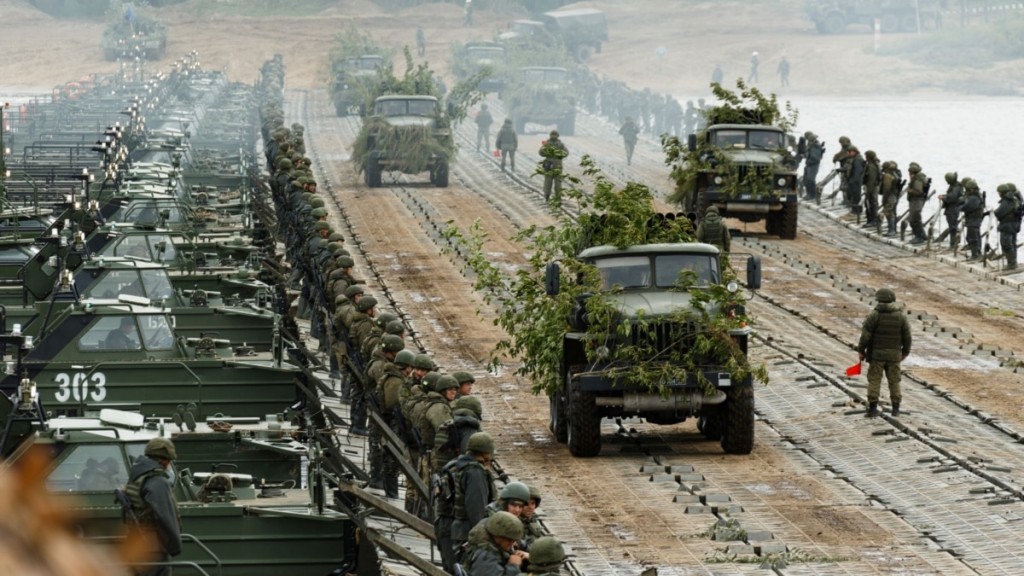
Russia said it was pulling back more forces from around Ukraine on Wednesday, the latest move in an apparent effort to ease tensions that has done little to assuage Western fears the Kremlin might be planning an imminent invasion of its neighbor.
Moscow says that it is pulling back some of the 150,000 troops that the United States and its allies warn have converged around Ukraine on three sides. But with the world searching for signs that a deadly new conflict on European soil might be averted, days of high-stakes signaling from Russia have been met with skepticism by the West.
"We continue to see critical units moving toward the border, not away from the border," Secretary of State Antony Blinken told MSNBC’s “Morning Joe” on Wednesday. “There’s what Russia says and then there’s what Russia does — we haven’t seen any pullback of its forces.”
He added, "It would be good if they followed through on what they said, but so far we haven’t seen it.”
In Kyiv, where Ukraine's leaders have sought to play down that alarm, the country held a defiant national day of unity.
Meanwhile, in an apparent bid to back up its claims of a partial withdrawal, the Russian defense ministry released video showing a trainload of armored vehicles moving across a bridge away from Crimea, the Ukrainian peninsula that Moscow annexed in 2014.
It followed a similar announcement a day earlier, while Russian President Vladimir Putin also talked up the possibility of a diplomatic resolution to the crisis.
But leaders in Washington and Europe have urged caution, with Moscow's intentions unclear and little detail given about how many troops were pulling back and where they were headed.
Ukraine’s foreign minister, Dmytro Kuleba, tweeted Wednesday that “statements on withdrawal aren’t sufficient. We need transparency and facts.”
NATO Secretary-General Jens Stoltenberg told reporters in Brussels that in fact Russia had "increased the number of troops — and more troops are on the way."
After meeting with NATO defense ministers on Wednesday, Stoltenberg said at a press conference that the alliance has not seen "any sign of de-escalation on the ground — no withdrawals of troops or equipment."
Russia has a "massive invasion force ready to attack with high-end capabilities from Crimea to Belarus," Stoltenberg said, noting that it's the largest build up of forces in Europe since the Cold War.
NATO sent "concrete proposals" on transparency, risk reduction and arms control and has not received a response from Russia, Stoltenberg said. He described Russia's efforts to use its military to "intimidate" other countries as "the new normal in Europe," which he said has prompted defense ministers to develop options Wednesday to strengthen NATO's deterrence and defense. One option, he said, involves establishing new NATO battlegroups in central, eastern and southeastern Europe.
In a joint written statement Wednesday, NATO defense ministers said their strategy also involves "additional land forces" as well as "additional maritime and air assets." The ministers described the measures as "preventive, proportionate and non-escalatory."
Meanwhile, Ursula von der Leyen, president of the European Commission, called it “the largest build-up of troops on European soil since the darkest days of the Cold War.”
 World
World  World
World  World
World  World
World