

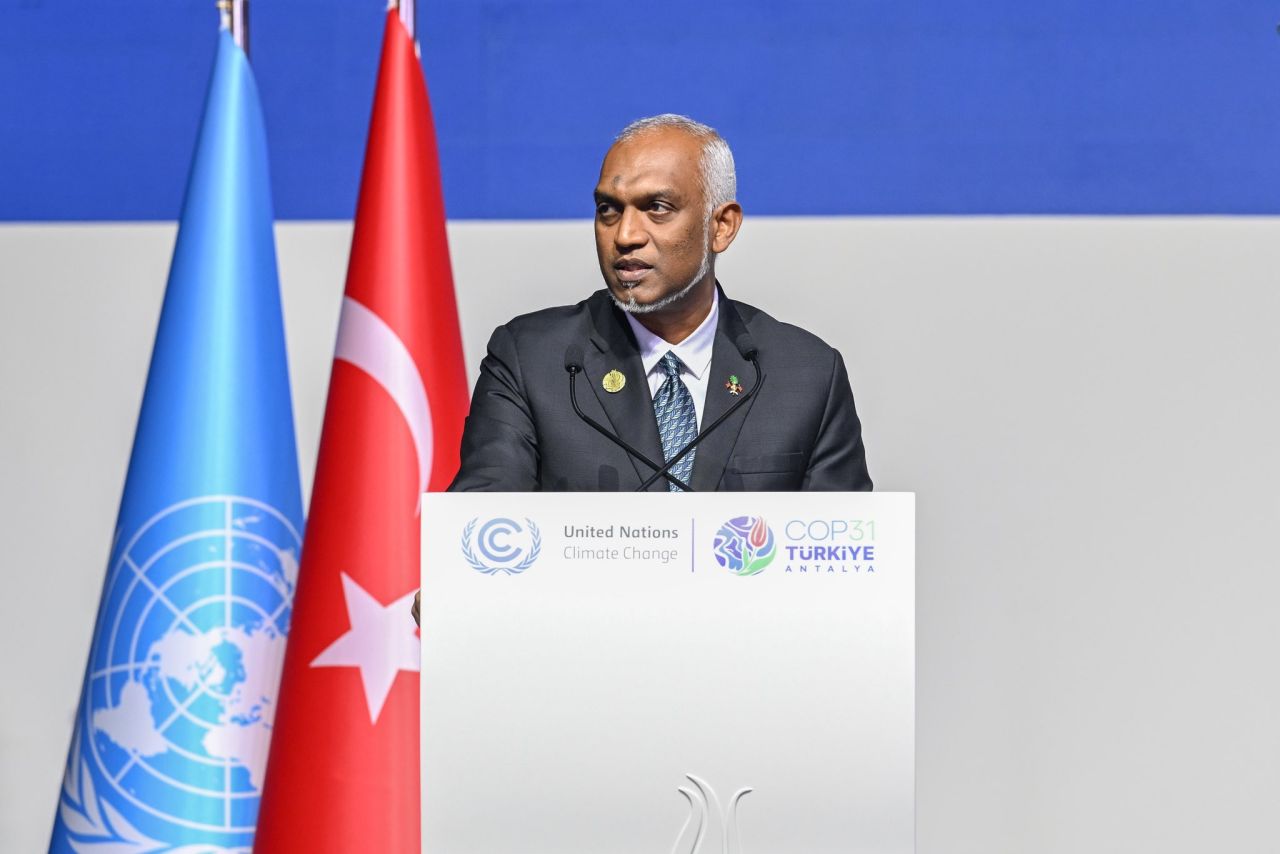
President Dr Mohamed Muizzu has reaffirmed the Government’s commitment to protecting the Maldives’ islands and communities from rising sea levels, stressing that the country’s future must not be defined by its climate vulnerability.
The President made the remarks today at a session organised by the UN Global Centre for Climate Mobility (GCCM) on strengthening resilience to sea-level rise in small island states, held on the sidelines of the COP31 Summit in Antalya, Türkiye.
He described rising sea levels as a major development challenge and a direct threat to the Maldives’ continued existence. He emphasised that the country’s islands are more than just land, representing the homes, history and identity of the Maldivian people. Protecting their right to live on their islands, he said, remains a national priority.
The President highlighted ongoing efforts to strengthen coastal protection and preserve natural defences, including reefs and lagoons. He also stressed the importance of ensuring that communities have access to the data and financial resources needed to prepare for climate change.
Referring to major development projects, President Dr Muizzu described Hulhumalé as a strategic investment in climate resilience, developed on elevated land. He also highlighted Rasmalé as a low-carbon eco-city being developed at an elevation above projected sea levels and designed to be powered by renewable energy.
He said these projects support the Maldives’ vision of becoming a fully developed nation by 2040, stressing that climate resilience must be integrated into development planning rather than addressed only after disasters occur.
The President also called for climate-induced displacement to be incorporated into climate planning and urged the provision of adequate, predictable and accessible climate finance. He stressed that climate finance should be provided as grants, rather than charity, describing it as a matter of climate justice.
He reaffirmed the Maldives’ commitment to protecting its islands and ensuring that future generations can continue to live, build and prosper on their ancestral land.
 News
 News
 News

ކޮމެންޓް