
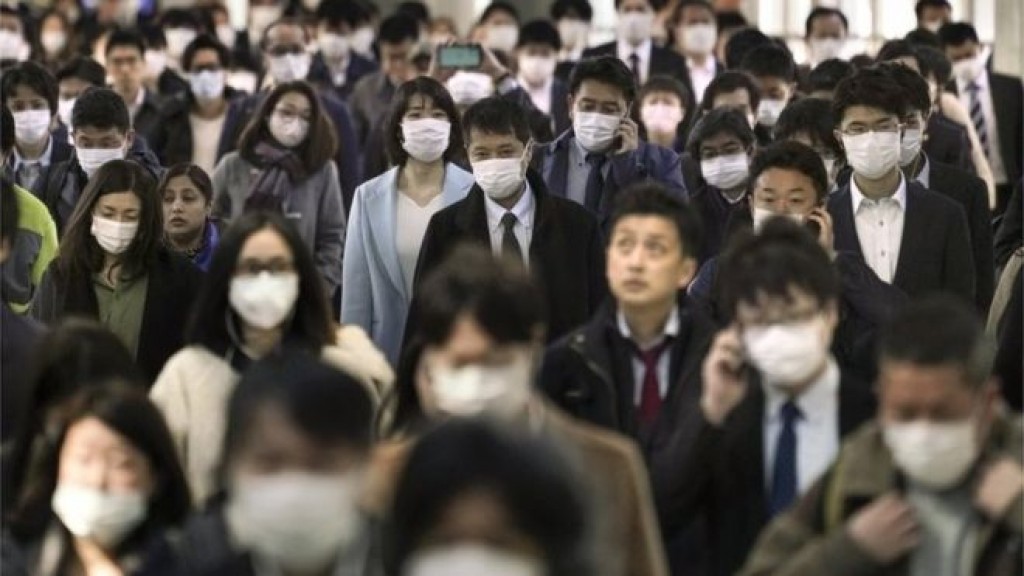
Japanese Prime Minister Shinzo Abe on Tuesday declared a state of emergency to fight new COVID-19 infections in major population centres, and unveiled a stimulus package he described as among the world's biggest to soften the economic blow.
Abe announced the state of emergency targeting the capital Tokyo and six other prefectures - accounting for about 44 per cent of Japan's population - for a period of about one month.
The other affected regions are neighbouring Chiba, Kanagawa and Saitama, the western hub of Osaka and neighbouring Hyogo, and the southwestern region of Fukuoka.
"We have decided to declare a state of emergency because we've judged that a fast spread of the coronavirus nationwide would have an enormous impact on lives and the economy," he told parliament earlier.
"The most important thing now is for each citizen to change our actions," Abe said in televised comments made at a meeting of a government task force.
"If each of us can reduce contact with other people by at least 70 per cent, and ideally by 80 per cent, we should be able to see a peak in the number of infections in two weeks," he said.
His Cabinet will also finalise the stimulus package worth 108 trillion yen (US$990 billion) - equal to 20 per cent of Japan's economic output - to cushion the impact of the epidemic on the world's third-largest economy.
 World
World  World
World  World
World  World
World